
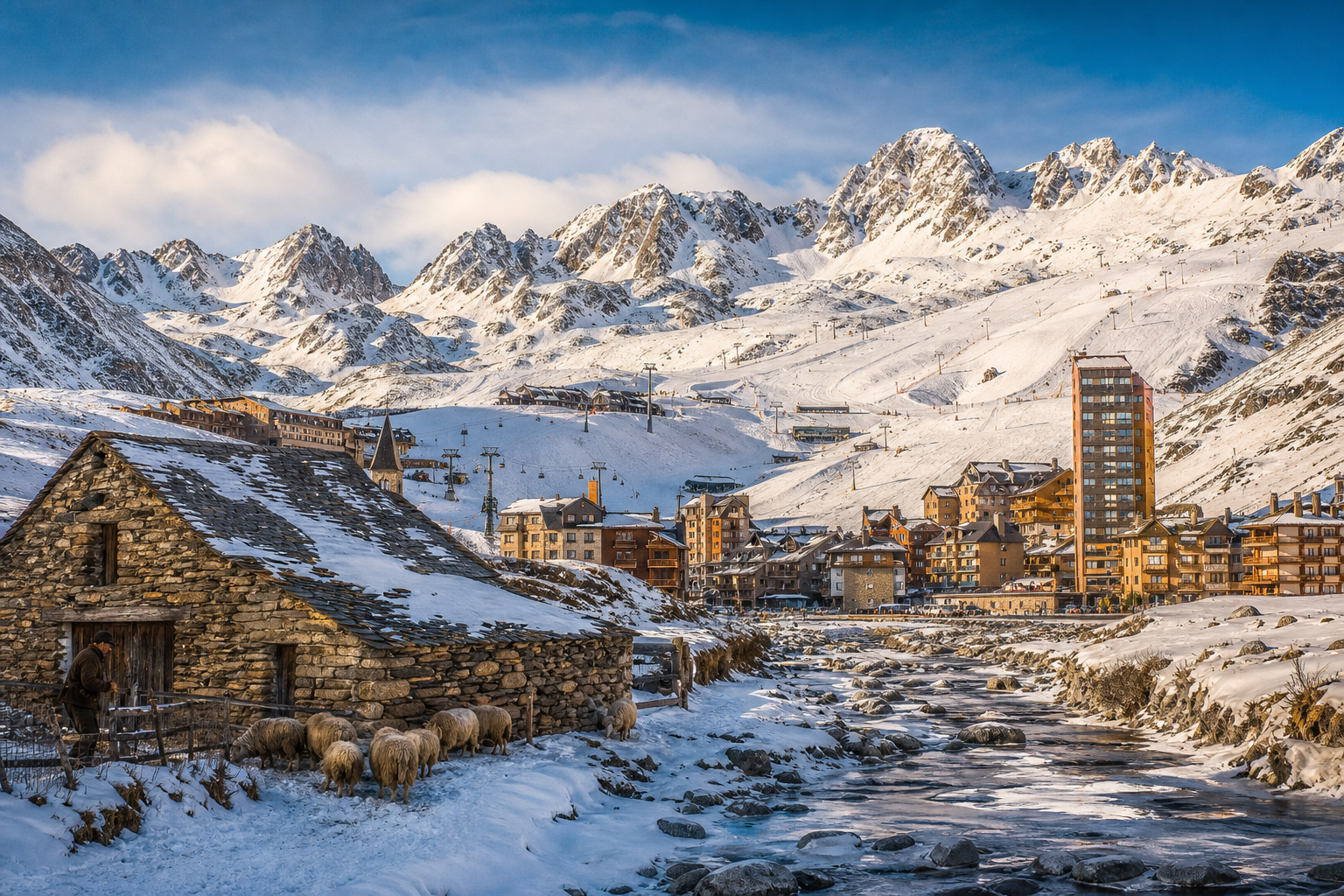
Pas de la Casa did not begin as a ski resort or a shopping destination. It started as little more than a shepherds’ hut in a remote corner of the Pyrenees. In less than a century, it grew into one of Andorra’s most international towns—one of the country’s most remarkable transformations.
A hut by the river, right on the border
Before there was a village, this landscape consisted only of summer pastures known as La Pleta and El Saliner, where livestock farmers from Cerdanya and the Upper Ariège brought their herds. The only building was the Cabana del Vaquer, a simple livestock shelter. In 1928, a man known as “Calones” (Miquel Montanya) asked the local council for permission to build a hut beside the river, directly on the French border. That seemingly minor event is regarded as the origin of today’s town.
The road that changed everything
A year later, in 1929, construction of the road to France brought workers and attracted the attention of the authorities. France established a customs post in the area, followed soon afterwards by Andorra’s own checkpoint. In just a few years, this mountain pass changed from an occasional crossing point into a strategic link between two countries.
Wooden huts, trade and the smuggling years
During the Second World War, while France suffered severe shortages, Pas de la Casa discovered its first commercial calling. Traders such as Amadeu Cirici began bringing goods from across the Spanish border—food, clothing, coffee and chocolate—to sell to French visitors, helped by lenient customs controls. Within a few years, half a dozen wooden huts were enough to serve a steadily growing and loyal clientele. The authorities eventually curbed this makeshift development, banning new wooden structures and encouraging construction of the town’s first stone building in 1948.
1956: the year skiing arrived
The real transformation came with the snow. In 1956, Francesc Viladomat promoted the construction of Pas de la Casa’s first ski lift, a 2,000-metre installation running from the village up to Pic Blanc at an altitude of 2,500 metres. It opened in the winter of 1956–1957 and almost overnight changed the town’s destiny: from a commercial stopover into a ski destination that first attracted French visitors and later Spanish skiers as well.
From border village to international destination
During the 1960s, Pas de la Casa modernised at great speed, gaining running water, electricity, telephone service, heating, a school, a pharmacy and paved roads. In 1967 it even welcomed French president Charles de Gaulle, who came to see the Sud Radio station built a decade earlier above the town. Encamp’s local council regulated growth through seventy-year land-use agreements, giving a legal framework to an expansion that would no longer stop.
A past that visitors will soon be able to explore
Today, almost one hundred years after “Calones” requested permission to build his hut, Pas de la Casa remains synonymous with shopping, snow and mountains. Encamp’s local council and the Government of Andorra are already working on a permanent exhibition devoted to this history, planned for the town’s tourist office. Until that project opens, learning about the origins of Pas de la Casa helps explain how this corner of the Pyrenees, born from a simple hut, became one of Andorra’s most distinctive and visited towns.